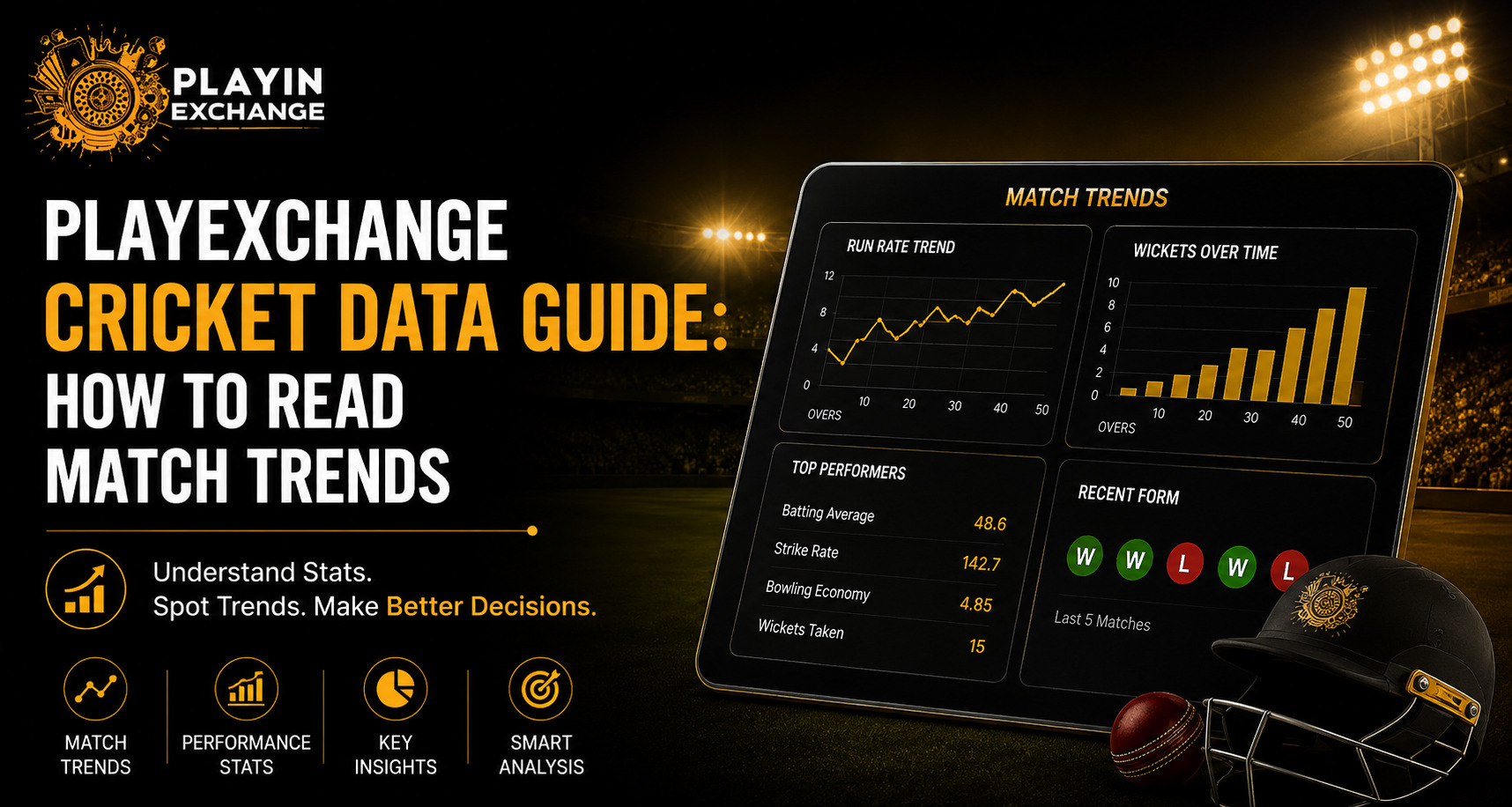
Cricket has become increasingly data-driven, with fans using statistics to understand team performance, player form and changing match situations. A scorecard provides the basic numbers, but deeper cricket data can reveal patterns that are not immediately obvious. Understanding these trends can make match coverage on Playexchange more informative and easier to follow.
Why Cricket Data Matters
A cricket match can change quickly, and individual numbers only tell part of the story. Looking at several statistics together provides better context.
Useful areas of cricket data include:
- Recent team form
- Batting performance
- Bowling figures
- Run rate
- Wickets lost
- Partnerships
- Boundary percentage
- Powerplay performance
- Death-over scoring
- Player consistency
These numbers can help explain how a team has reached its current position.
Understanding Team Form
Team form refers to how a side has performed across its recent matches.
When reviewing form, fans can consider:
- Recent wins and losses
- Strength of opposition
- Home and away performances
- Batting consistency
- Bowling effectiveness
- Results in the same format
Recent results are useful for context, but they should not be treated as a guarantee of what will happen in the next match.
read also : Playexchange Guide How to Balance Entertainment and Discipline on Online Gaming Apps India
Batting Trends to Watch
Batting data can show how a team builds its innings.
Important indicators include:
Powerplay Scoring
The opening overs can establish the foundation of a limited-overs innings. A team that scores quickly while protecting wickets may create a strong platform for the middle overs also u can playexchange login manage your account.
Middle-Overs Stability
The middle overs often involve rotating the strike, building partnerships and managing wickets.
Death-Overs Acceleration
The final overs can produce a significant increase in scoring, particularly when a team has wickets available.
Looking at these three phases together gives a better understanding of an innings than the final total alone.
Bowling Trends and Match Pressure
Bowling statistics can reveal how effectively a team controls scoring.
Fans can examine:
- Economy rate
- Wickets per innings
- Dot-ball percentage
- Powerplay wickets
- Middle-over control
- Death-over economy
A bowler who concedes few runs may create pressure even without taking frequent wickets.
Similarly, a wicket-taking bowler can change the match even if their economy rate is higher.
Why Partnerships Are Important
Partnerships can dramatically influence a team’s innings.
A long partnership may:
- Stabilise the batting order
- Recover from early wickets
- Increase scoring confidence
- Force bowling changes
- Create pressure on the opposition
A partnership should therefore be considered alongside the overall score and number of wickets remaining.
Comparing Current and Required Run Rates
During a chase, two numbers are especially important.
The current run rate shows how quickly the chasing side has scored so far.
The required run rate shows approximately how quickly the team needs to score to reach the target within the remaining overs.
Comparing the two provides a quick indication of whether the chase is moving comfortably or becoming more demanding.
Player Form Needs Context
A player’s recent statistics can be useful, but context matters.
For example, a batter’s recent runs may have come against different bowling attacks or under different pitch conditions.
When evaluating player form, consider:
- Opposition quality
- Match format
- Venue
- Batting position
- Number of innings
- Recent workload
This prevents one statistic from being interpreted without context.
How Match Conditions Affect Data
Statistics can change significantly according to conditions.
Pitch behaviour, weather, boundaries and dew can influence scoring and bowling performances.
A low-scoring match does not necessarily mean poor batting. It may reflect a difficult pitch or strong bowling attack.
Likewise, a high-scoring game does not automatically indicate weak bowling.
Using Historical Data Carefully
Historical statistics can help identify patterns, but cricket is constantly changing.
Teams change their playing XI, tactics and strategies. Players also develop or experience changes in form.
Historical information is therefore best used as supporting context rather than as a prediction of a guaranteed result.
How to Read Match Data Efficiently
Fans can follow a simple process:
- Check the current score.
- Review wickets and overs.
- Look at the current partnership.
- Compare current and required run rates.
- Review key batting statistics.
- Check important bowling figures.
- Consider the match conditions.
- Compare the data with the broader match situation.
This approach makes large amounts of cricket information easier to understand.
Why Data Quality Matters
Accurate statistics are essential for meaningful cricket analysis.
A reliable cricket information page should clearly distinguish between:
- Live match information
- Confirmed scorecard data
- Historical statistics
- Pre-match information
- Commentary updates
Clear presentation helps fans understand what is happening without confusing current information with older records.
Responsible Use of Cricket Statistics
Statistics are useful for understanding matches, but they cannot guarantee future results.
A team’s previous performance may provide context, while player statistics can highlight strengths and weaknesses. However, unexpected events such as injuries, weather changes, pitch behaviour or sudden changes in momentum can influence any match.
The best approach is to use cricket data as an information tool rather than treating it as certainty.
Key Takeaways
- Cricket data provides deeper context than a basic score.
- Team form can help explain recent performance.
- Batting trends differ across powerplay, middle and death overs.
- Bowling statistics reveal control and wicket-taking impact.
- Partnerships can change the direction of an innings.
- Current and required run rates are important during chases.
- Player statistics should always be considered in context.
- Historical data should support analysis rather than guarantee outcomes.
Frequently Asked Questions
What is cricket match data?
Cricket match data includes statistics such as runs, wickets, overs, strike rate, economy rate, partnerships and other performance figures.
Why is team form important?
Team form provides context about recent performances, although it cannot guarantee the outcome of a future match.
What is required run rate?
Required run rate is the approximate scoring rate a chasing team needs to maintain to reach its target within the remaining overs.
Why are partnerships important?
Partnerships show how two batters contribute together and can explain periods of recovery, stability or acceleration.
Can cricket statistics predict a match result?
Statistics can help explain trends and situations, but they cannot guarantee a future result.